Showing posts with label Temkin. Show all posts

Friday, May 28, 2010

Can A Company "Evolve" Into Premier Service Provider? Yes, But Few Make It!

A critical question has been bouncing around my brain for the last week or so, and that is:

Can a company truly transform itself into a premier service organization, or must the company be "born" with that as its central mission?

It is easy to find examples of companies that make service excellence "the" key competitive dimension--think Zappos, Ritz, and JetBlue. But the question is whether these companies began ascendancy as premier organizations, or were transformed into premier organizations as a result of changes to a failed business strategy.

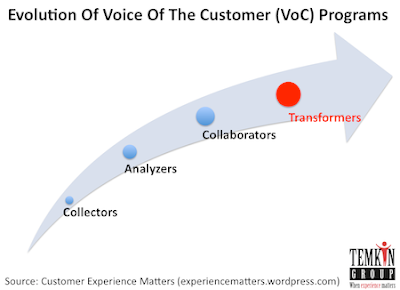
Bruce Temkin of the Temkin Group talks about Customer Experience maturity in a recent post in his blog Customer Experience Matters. http://experiencematters.wordpress.com/2010/05/19/how-voice-of-the-customer-programs-evolve/ He cites four stages of company evolution:

  • Collectors--company focuses on getting the right data.
  • Analyzers--company focuses on uncovering insights from the data.
  • Collaborators--data insights are used to help departments understand issues, help continuous improvement efforts.
  • Transformers--data insights are linked into most departments operations and strategy.

Bruce estimates that 40% of companies trying to create a premier customer experience are in the Collector stage, 40% are in the Analyzer stage, 18% are Collaborating, and only 2% are actually Transforming.

What does this say? It says that although many companies are indicating they want to invest in delivering premier customer service, few are getting any benefit from their efforts. Only 20% are getting the customer's voice into their decision making, and only 1 in 50 companies are actually making the customer central to their operations and strategy.

Since there are companies that are truly Customer-centric in their approach, this begs the question: did these companies follow the steps that Temkin outlines, or did they grow up already transformed. Can companies evolve?

My View:

Ouch! This data further confirms my belief that senior management in many companies are saying the words (80% of companies say they want to compete based on superior customer experiences) but are not doing what is necessary to get there. This strategic positioning runs the risk of being a "thing"--something all companies have to say because it is fashionable to do so--rather than a substantive business initiative.

Many companies that are the benchmarks for premier service have benefitted in terms of marketshare from that positioning, and have grown profitably as a result. Without knowing the companies Temkin has listed in the 2%, my bet is that many of them have grown up as "transformers."

Does this mean that if your company is in the middle of the service experience pack today that it cannot differentiate itself in the future? Not at all. But the executive "rubber meets the road" work begins when the company has gathered data and gained insight. The executive needs to make critical organizational changes that features that data, improves customer experience based on that data, and makes business priorities using the voice of the customer. In short, the executive needs to believe in the strategy and the data, and drive the company.

Without that, the company will never evolve and reach tranformative stages. Most will not. Enlightened and focused companies can.


Monday, March 29, 2010

"Customer Experience" In All Industries Needs Same Process As Service Companies

When I study lists of companies that claim to want to differentiate competitively based on customer experience, I am heartened to see companies that I wouldn't have associated with "services" beginning to focus on the customer. Retail stores, computer companies, telephone companies, car dealers, are all sounding like pure service organizations these days. Clearly, the "purchase" experience or the "usage" experience, or even the "disposal" experience, are all important when thinking through satisfaction.

"When the customer is centric to the company's design, changes throughout the company happen!"

For example, in the retail world, some of the steps a shopper walks through in a store will add up to a good or bad customer experience. From Bruce Temkin at Forrester Research, http://experiencematters.wordpress.com/2010/03/29/walgreens-rolls-out-customer-centric-retailing/ many of these stores are now focusing on each opportunity and redesigning stores to accomodate. Steps include:

Wayfinding: From walking into the store until you find the right area
Browsing: Comparing multiple products within a category
Studying: Evaluating an individual product or products
Getting Help: Finding answers to questions along the way

So some stores are changing shelf heights and widening aisles, limiting variety of each item, providing more information about choices, and training clerks to be more informed. All in the name of improving the customer experience.

My View

The new thinking about "Customer Experience" can be useful when designing an overall premium service offering.

For those companies, such as retail stores, who depend upon sales of tangible goods, premium customer experience will lead to location loyalty and more sales of those goods. When the customer is centric to that company's design, changes throughout the company happen. For that retail store, reduced inventory means less dollars spent on idle merchandise and more focus on developing knowledgeable staff.

Most interestingly will be how these companies gain insight as to how well these changes are satisfying their customers. And then what process is used to continually improve these experiences.

This becomes even more critical when "service" is the good that is sold. Therefore, how the service is offered, delivered, consumed, and evaluated, must be designed in a way that satisfies the customer.

Monday, June 8, 2009

Healthcare Company Objectives: To Be Prettiest Pig On The Truck

A bit of disturbing research was recently published by Forrester showing that customer satisfaction of the health plan industry is poor and heading lower. Should that surprise anyone? No...not with prices rising, co-pays and deductibles increasing, and coverages more restrictive than ever. Here are some of the results from the Forrester research from Bruce Temkin in his blog "Customer Experience Matters":

In Forrester’s 2008 Customer Experience Index (CxPi), we ranked 113 companies across 12 industries. I recently published a snapshot of the health plan industry looking at the results from the eight plans on the list (Aetna, Anthem (BCBS), CIGNA, Kaiser, Medicaid, Medicare, TriCare, and United Healthcare). Here’s some of what we found:

--Experiences are “very poor” and getting worse. As a group, the eight health plans ended up with a “very poor” rating of 51%; the lowest score of any of the 12 industries we examined. Making matters worse, the industry dropped three percentage points
from the 2007 CxPi results.

--Kaiser led the pack. With an “okay” score of 70%, Kaiser led all health plans. All of the other plans ended up with ratings of either “poor” or “very poor.”


--Medicaid is as bad as it gets. With a terrible rating of 38%, Medicaid was the lowest scoring plan. It also ended up in next to last place across all 113 organizations in our rankings.

--Only Kaiser improved. When we compared the 2008 results with those from 2007, only Kaiser showed an improvement. CIGNA and Medicaid, on the other hand, declined the most.
Some big shifts in CxPi components. There were five double-digit changes in the scores for the three underlying elements of the CxPi: Kaiser’s improvement in being easy to work with and enjoyability, Anthem’s decline in enjoyability, and both CIGNA’s and Medicaid’s drop in being easy to work with.


My view:

The Health Benefit industry is headed toward a cliff, with people paying a lot of money and not feeling like they are getting the service they are paying for. There are lots of reasons for dissatisfaction, many of which are not related to the service itself, but many are--such as the "easy to work with" category."

Service has not been a priority for these firms in the past. Controlling costs has been. I have heard management at healthcare companies say that their goal is to provide service that is just good enough, but not great, thinking it will be too expensive to provide service that makes clients/employees happy. The phrase "prettiest pig on the trust" describes their goal...not a lofty objective.

Further, health plans are viewed as marquee benefits for companies. Can you imagine spending millions on a "benefit" that no one is happy with? Companies will soon see that the money spent is not worth the aggravation, and look for other ways to provide coverage...like cheaper Consumer Directed Health Plans....or no coverage at all.

That is, unless a company, like Kaiser, steps up and shows you can provide service at a satisfactory way, and make the case that it benefits the company to have good service for its helathplans. There is clear opportunity for health benefit companies to step up here....and differentiate based on service....Perfect Service!


Tuesday, May 26, 2009

Great Read About Customer Satisfaction

Bruce Temkin from "Customer Experience Matters" blog recently hit a milestone with his 366th blog post. He summarized many of his recent posts in a recent article. This is one of my favorite blogs to read because Bruce takes the research he and Forrester gather and publishes his views about them. While not directly related to the Benefits Business, many of the lessons are universal.

Here are some snippets that I selected from Temkin's summary:

The maturing of customer experience. Forrester’s second annual Customer Experience Index that rated 113 organizations across 12 industries showed that there’s a lot of opportunity to improve. This also showed up when consumers rated Web, phone, and in-person interactions in Experiences That Satisfy Consumers, 2009, The good news is that customer experience management is definitely maturing which I highlighted in the following posts: Customer Experience Grows Up, Six Trends Reshape Voice Of The Customer Programs, and The State Of Customer Experience.

Customer experience correlates to loyalty. In
Customer Experience Correlates To Loyalty, I found that customer experience correlates to three key elements of loyalty: willingness to repurchase, reluctance to switch, and likelihood to recommend. And the correlations got even stronger since 2007. I dug a bit deeper into the data in More Info On Customer Experience And Loyalty.

Building a customer-centric culture. Culture is a key ingredient for good customer experience — so I introduced the
6 C’s Of Customer-Centric DNA. And it’s also why I told execs that they need to Invest In Culture As A Corporate Asset. Other posts that looked at culture included: The Cultures Of Best Buy, Google, GE, And Semco, WL Gore Succeeds Without Employees, At Four Seasons, Customer Experience Is Everyone’s Business, and Execs Need To Focus More On Culture.

Managing through the recession. I’ve been writing a lot about how to manage in a recession. Here are some of the key posts in this period: Recession Strategies From IDEO And Potatoes, Jeff Immelt On Managing In A Downturn, Turn Hard Times Into Goat Stew, Recession Leadership: Be Real, Communicate, And Look Ahead, Retail Execs Discuss Leading In A Recession, Learn From Home Depot And Macy’s, But Not Office Depot, and Lessons From Condoms And Canned Goods.

Customer service is a critical experience. In Don’t Confuse Customer Service With Customer Experience, I made the point that customer service represents a critical set of customer experiences. That became crystal clear from consumer responses in Customer Service Trumps Price. Who’s doing well? Look at Customer Service Champs From BusinessWeek.

The Apple/Windows customer experience battle. As part of my
Customer Experience Index research, I publish snapshots on the results in 12 industries. It turned out that my PC industry snapshotcaused quite a stir. It was picked up by major news outlets, a ton of bloggers, and drove many comments on my blog. I felt the need to clarify my view in another post about the results. Apple even created a Mac ad that referenced the results.

I encourage my readers to check out Bruce's blog regularly!