A few years ago, I took my operations management team on a field trip in downtown Hartford, Connecticut. The destination? Fast food restaurants. The purpose? To experience how process design impacts customer experience, and ultimately the success of the establishment.
Our first stop: McDonalds. The five of us crammed into a tight crowded area, spreading out into separate lines in front of a register. The five order takers were busily moving their specific lines as fast as they could, but large complicated orders were clogging up the line, slowing the pace. While the order was being filled, people milled in front of the register waiting. And when the food arrived, people would grab napkins, stirrers and straws from containers at the register. The result: A crowded mess and unhappy customers.
Lesson learned: In that location, McDonalds probably did 75% of its overall business during lunch, yet it was clear that the lobby was just not big enough. The separate lines for each register, the lack of space for waiting customers, and the fulfillment of napkins at the same place made the purchase experience completely problematic.
Our next stop: Wendy's. When we entered the restaurant, there was a feeling of order...a single line organized with rope barriers guiding people. When a register opened, the next person in line moved to that spot. When the single line became long, a Wendy's person came out and took orders for each person in line, giving them a slip of paper to hand to the register clerk for faster ordering and payment. Once an order was given, the customer shifted to the side where condiments and napkins were available, making plenty of room for the next customer. Once the order was ready, the customer was called, and the food was given. The result: a fast and responsive system.
Lesson learned: Given that orders are not uniform, the Wendy's line systen eliminated the unlucky line selection from the process. As well, the ordering and the fulfillment process were separated so as to keep the flow moving. Lastly, when the line queued up during rush hour, Wendy's employees came out from behind the counter to take "pre-orders" so that when the customer made it to the register, the transaction was sped up dramatically.
Our last stop: Sbarro's Italian. This food setup is cafeteria-style, in that customers take a tray and single file move their way through the selections. Seeing and smelling the food was a lot different than just ordering from a board. HYowever, the speed of this process was totally dependent upon the orders of the people in front of you. If you just wanted a slice of pizza and a fountain drink, the speed of your order may be a minute if the line is short, but 10 minutes if the person in front of you ordered four calzones. The result: the potential for extreme delay.
Lesson learned: Single queues with variable service times may be the easiest of all processes to set up, but have the real potential to clog up. Here you are only as fast as the slowest order.
My View:
Commitment to service is more than just enthusiastic employees and encouraging posters. Sometimes the commitment is also in the thoughtful design of the service delivery itself.
These three restaurants were within a block of each other, competing for basically the same clientele...the business employee. The criteria--good food in quick delivery--was the same for all three. Yet, each designed its delivery differently...and according to my operation management team, with different results.
Wendy's clearly understood and designed its process to deliver. Its single line system with different areas for ordering and pickup sped up the process. Its contingency plan to take pre-orders enabled the process not to get bogged down the volumes increased.
McDonalds was poorly designed, from process to lobby space. The entire experience left the customer wanting better.
And Sbarro's restaurant, while showcasing its food, created a potential for severe bottlenecks, especially for those ordering quick items. When a slice and a Coke take 15 minutes to order, no matter how good the food is, the customer will be unhappy.
When a company makes the commitment to deliver permium service, understanding how it is delivered and the impact on satisfaction is critical. Then the company can design its processes to deliver. This is one of the themes within "Perfect Service."
Showing posts with label Perfect Service. Show all posts
Showing posts with label Perfect Service. Show all posts
Monday, December 6, 2010

Wednesday, August 11, 2010
Perfect Service Magic Comes From Wowing Current Customers
Not Related But A Funny Advertisement About Service
I am spending some time in Wisconsin these days, and I noticed an interesting phenomenon on the radio. At least 80% of the advertisements for local businesses promoted their high levels of service, their moneyback guarantees, and their industry rankings for satisfaction. All types of businesses were advertised: health insurance, roofers, car dealerships, and security firms. And most tried to position themselves as the market's service leader.
I am of two minds about this:
1. I think it is great that companies believe selling service satisfaction is a viable competitive weapon. They are counting on a sizable segment of the population to positively respond to the idea that being satisfied with the service is more important than having the lowest price or the most progressive features.
2. I worry that promotion of premium service is not over-hyped to the point of numbness. And that this is viewed as a way to get new customers, and then under-delivered. It reminds me that 80% of companies in a recent survey said they wanted to use the customer experience as a competitive differentiator, yet only 40% had any type of formal service program in place.
I hope that these offers are truly well thought out, and that when customers are attracted to the offering, the company can deliver on the promise. After all, saying you have the best service is easy to do, but much harder to deliver.
My View
While advertising for new customers is important, Perfect Service programs focus on your existing customer.
- By delivering a premier experience to that customer, an asset is created that continues to grow. The customer will stay with you, buy more from you, and serve as a reference for future sales.
- The customer experience is designed based on a model for a "perfect" or ideal transaction. All aspects of the delivery of that perfect transaction are measured and improved upon. The feedback is frequent and instantaneous.
- Satisfaction is unconditionally guaranteed.
- Client satisfaction success stories are trumpeted throughout the organization.
Only then can a company confidently go to the marketplace and tout its services. And the experience will match the promotion.
Tuesday, July 27, 2010
SuperGuarantees and Angie's List Are Changing How Consumers Make "Perfect" Choices
At its core, Perfect Service is based on delighting customers through guaranteed offerings. These customers will then stay with you, buy more from you, and help attract others to you. A formula for success and growth.
One of the most important elements for establishing a "Perfect Service" program is to establish and boldly promote a "Perfect Guarantee." This one act sends a message to potential customers, as well as current clients, that your company is serious about providing satisfaction.
Another element is for your customers to promote their happiness with your services. Companies need to get creative in how they get the word out.
I am seeing a lot of work being done in both of these areas, and while I believe they are not fully developed, the trend is a good one:
SuperGuarantee Designation
Consider the Phone Directory....in recent years, these businesses have been a major victim of technology advancements with online and mobile data replacing the hefty phone book. When I need a phone number, I no longer even think about using the book or even the Phone Directory's website. I can go direct to the provider's website or query my search engine for a listing of providers. If most people this this way, why would businesses advertise in Phone Directories any more?
Lately, I have begun seeing advertisements from the Yellow Pages about a new program called the "SuperGuarantee." In short, if a consumer registers with the SuperGuarantee service and selects a service provider from the Yellow Pages listings that has a "SuperGuarantee Shield" designation, the work is guaranteed. If work is not completed satisfactorily, the service will mediate the conflict and, if still not satisfied, will pay the consumer $500 for the trouble. (Obviously lots of terms and conditions apply, but the concept is clear.)
For businesses, the SuperGuarantee "Shield" is given to companies who meet advertisement criteria of the Yellow Pages. There is no review of services, no adhering to specific business practices, etc. You pay for the advertisement, and you get the Shield at no extra charge. The Shield means that the SuperGuarantee company will guarantee the work, not the service company.
Collecting Service Reviews
 Another service that is also growing is one called "Angie's List," where members can access "thousands of unbiased reports and reviews abouth service companies in your area." Again, the concept is simple: consumers report their experiences and members can review these experiences before buying a service. Should there be a problem with the service, Angie's List members also have access to a "conflict resolution team" that will try to settle the dispute.
The only way for a company to be listed is to have performed a service, and have that service experience reported and rated by a member. Companies, however, are permitted to advertise discounts to members, but only if they have an A or B rating.
While there are no guarantees offered, the collection of unbiased reports assist consumers in making the right choices.
My View
When selecting service providers, consumers are constantly looking for ways to sift through all of the information available to pick the right provider. Horror stories abound about the impact of bad decisions.
SuperGuarantee spotlights service providers with its "Shield," offers provider conflict resolution services, and offers a financial guarantee if the experience fails. But service providers get listed if they advertise in the directory, not if they provide premier service--this lack of screening is a problem.
Angie's List delivers user-generated reviews on service providers, offers provider conflict resolution services, and has some membership benefits like discounts to services reviewed. But the consumer is powerless should the provider not perform, other than the power of a bad review in Angie's List. I am not sure this is enough of a deterrent.
I believe, however, that both services are on the right track. Consumers need help to wade through the potential providers of service, and both get partially the way there. Perhaps, each company can take their service a step further:
One of the most important elements for establishing a "Perfect Service" program is to establish and boldly promote a "Perfect Guarantee." This one act sends a message to potential customers, as well as current clients, that your company is serious about providing satisfaction.
Another element is for your customers to promote their happiness with your services. Companies need to get creative in how they get the word out.
I am seeing a lot of work being done in both of these areas, and while I believe they are not fully developed, the trend is a good one:
SuperGuarantee Designation
Consider the Phone Directory....in recent years, these businesses have been a major victim of technology advancements with online and mobile data replacing the hefty phone book. When I need a phone number, I no longer even think about using the book or even the
 Phone Directory's website. I can go direct to the provider's website or query my search engine for a listing of providers. If most people this this way, why would businesses advertise in Phone Directories any more?
Lately, I have begun seeing advertisements from the Yellow Pages about a new program called the "SuperGuarantee." In short, if a consumer registers with the SuperGuarantee service and selects a service provider from the Yellow Pages listings that has a "SuperGuarantee Shield" designation, the work is guaranteed. If work is not completed satisfactorily, the service will mediate the conflict and, if still not satisfied, will pay the consumer $500 for the trouble. (Obviously lots of terms and conditions apply, but the concept is clear.)
For businesses, the SuperGuarantee "Shield" is given to companies who meet advertisement criteria of the Yellow Pages. There is no review of services, no adhering to specific business practices, etc. You pay for the advertisement, and you get the Shield at no extra charge. The Shield means that the SuperGuarantee company will guarantee the work, not the service company.
Collecting Service Reviews
Another service that is also growing is one called "Angie's List," where members can access "thousands of unbiased reports and reviews abouth service companies in your area." Again, the concept is simple: consumers report their experiences and members can review these experiences before buying a service. Should there be a problem with the service, Angie's List members also have access to a "conflict resolution team" that will try to settle the dispute.The only way for a company to be listed is to have performed a service, and have that service experience reported and rated by a member. Companies, however, are permitted to advertise discounts to members, but only if they have an A or B rating.
While there are no guarantees offered, the collection of unbiased reports assist consumers in making the right choices.
My View
When selecting service providers, consumers are constantly looking for ways to sift through all of the information available to pick the right provider. Horror stories abound about the impact of bad decisions.
Both the Yellow Pages SuperGuarantee and the unbiased reporting from
Angie's List attempt to help the consumer with this selection. Both are unique
in their approach, trying to add value to what is perceived as a high risk
transaction.
SuperGuarantee spotlights service providers with its "Shield," offers provider conflict resolution services, and offers a financial guarantee if the experience fails. But service providers get listed if they advertise in the directory, not if they provide premier service--this lack of screening is a problem.
Angie's List delivers user-generated reviews on service providers, offers provider conflict resolution services, and has some membership benefits like discounts to services reviewed. But the consumer is powerless should the provider not perform, other than the power of a bad review in Angie's List. I am not sure this is enough of a deterrent.
I believe, however, that both services are on the right track. Consumers need help to wade through the potential providers of service, and both get partially the way there. Perhaps, each company can take their service a step further:
- SuperGuarantee needs to establish a filtering mechanism so that only companies that provide excellent service be permitted to advertise a Shield. The right to advertise the Shield is a premium and should be earned.
- Angie's List should consider awarding its top companies its own version of the "Shield" to designate top providers according to its members. Then perhaps if members select companies with the "Angie Shield," Angie's List will guarantee or insure satisfaction with the work. That would make the user feedback a meaningful metric rather than just anecdotes.
Tuesday, June 29, 2010
After The Win, Companies Need To Deliver "A Perfect Conversion"
Your company has worked for weeks and months on positioning your services exactly the way you want. The client has given the right signals that it values your service proposition, and thinks your approach is intriquing. There seems to be a connection forming between the decision-makers and the sales team.
And then you get the word....you have won the big sale! Congratulations. Time to brew the pot of coffee...the real work begins.
Now comes a critical stage in the relationship...the Implementation or Conversion process. This stage is the first time your company moves from typical sales hype to reality of having to deliver what you sold. In many instances, this is a sobering time in the deal for both parties, one that Perfect Service companies need to critically analyze and design.
Bruce Temkin, in a recent blog post, describes this as the "Engagement Phase," the underappreciated stage between Point of Sale and Service. He believes that during this stage instead of worrying about collecting the proceeds from the sale, companies should focus on getting their customers satisfied. http://www.customerexperiencematters.wordpress.com/
The longer the transition period, more risk, and opportunity, a company has to reinforce its value proposition. Companies take this transition stage way too lightly.
My View
Many industries, particularly those delivering outsourcing services, experience long periods between sales and ongoing service. Typically, this stage is viewed as a technical experience as the service provider is taking its new client's detailed requirements and translating them into service capabilities. We are in the weeds here.
To perform this phase, most companies deploy a dedicated conversion or implementation team to the transaction. This team is staffed with Project Managers, Business Requirement Analysts, Technical Analysts, and other members of the Project Teams
To collect client requirements, there is a lot of client interaction and documentation, often with face-to-face meetings. Any confusion or details that are unclear are addressed here by this team.
In short, the conversion process is an intense learning experience, with frequent client interaction.
And once the conversion is completed and services are now live, the client is transferred to the Relationship Manager and the ongoing service organization. Several things can be improved with this typical arrangement:
1. Most of early relationship building is done with Conversion Team, not ongoing Service Team. The early meetings are where first impressions are created. While probably personable, the Project Manager's chief talent is most likely structure, detail clarity, and adherence to schedules.
2. Most client learning is experienced by Conversion Team, and although details are likely documented, the "soft" learnings are not as well as the conversations leading to specific decisions. As a result, client particulars must be "re-learned" by the service team.
3. There is often a lack of continuity in commitments made from sales to conversion to ongoing. This is understandable given that each group has its own objective. Unfortunately, that objective is rarely the same.
As Temkin describes: the main objective of Sales, Conversion and Ongoing Service should be the satisfaction of the client, not just the achievement of a departmental goal. Companies that recognize this will review their conversion processes with a different eye:
--Involving Client Service staff during the conversion process;
--Training Project Managers on the tenets of delivering satisfaction rather than merely the execution of the project;
--Identification and resolution of client dissatisfiers early in the Conversion process, rather than waiting for them during service delivery.
In Re-Engineering The Corporation, the classic business book, a view presented is that Conversion is just an extension of the sales process. That makes some sense, since business requirements and offerings are collected during the sales process and are used for implementating that business.
Instead, I offer the following thought: that Sales and Conversion are just the first part of the Service Process, and need to be as thoughtfully designed.
Now comes a critical stage in the relationship...the Implementation or Conversion process. This stage is the first time your company moves from typical sales hype to reality of having to deliver what you sold. In many instances, this is a sobering time in the deal for both parties, one that Perfect Service companies need to critically analyze and design.
Bruce Temkin, in a recent blog post, describes this as the "Engagement Phase," the underappreciated stage between Point of Sale and Service. He believes that during this stage instead of worrying about collecting the proceeds from the sale, companies should focus on getting their customers satisfied. http://www.customerexperiencematters.wordpress.com/
The longer the transition period, more risk, and opportunity, a company has to reinforce its value proposition. Companies take this transition stage way too lightly.
My View
Many industries, particularly those delivering outsourcing services, experience long periods between sales and ongoing service. Typically, this stage is viewed as a technical experience as the service provider is taking its new client's detailed requirements and translating them into service capabilities. We are in the weeds here.
To perform this phase, most companies deploy a dedicated conversion or implementation team to the transaction. This team is staffed with Project Managers, Business Requirement Analysts, Technical Analysts, and other members of the Project Teams
To collect client requirements, there is a lot of client interaction and documentation, often with face-to-face meetings. Any confusion or details that are unclear are addressed here by this team.
In short, the conversion process is an intense learning experience, with frequent client interaction.
And once the conversion is completed and services are now live, the client is transferred to the Relationship Manager and the ongoing service organization. Several things can be improved with this typical arrangement:
1. Most of early relationship building is done with Conversion Team, not ongoing Service Team. The early meetings are where first impressions are created. While probably personable, the Project Manager's chief talent is most likely structure, detail clarity, and adherence to schedules.
2. Most client learning is experienced by Conversion Team, and although details are likely documented, the "soft" learnings are not as well as the conversations leading to specific decisions. As a result, client particulars must be "re-learned" by the service team.
3. There is often a lack of continuity in commitments made from sales to conversion to ongoing. This is understandable given that each group has its own objective. Unfortunately, that objective is rarely the same.
As Temkin describes: the main objective of Sales, Conversion and Ongoing Service should be the satisfaction of the client, not just the achievement of a departmental goal. Companies that recognize this will review their conversion processes with a different eye:
--Involving Client Service staff during the conversion process;
--Training Project Managers on the tenets of delivering satisfaction rather than merely the execution of the project;
--Identification and resolution of client dissatisfiers early in the Conversion process, rather than waiting for them during service delivery.
In Re-Engineering The Corporation, the classic business book, a view presented is that Conversion is just an extension of the sales process. That makes some sense, since business requirements and offerings are collected during the sales process and are used for implementating that business.
Instead, I offer the following thought: that Sales and Conversion are just the first part of the Service Process, and need to be as thoughtfully designed.
Wednesday, June 16, 2010
Delta: Sometimes The Quality Of Service Is About The Art of Recovery
 In a private moment after a particularly tense meeting with an important client, the senior manager at the client wrapped his arm around my shoulder and said, "Sometimes the quality of service is about the art of recovery." That lesson stuck with me throughout my career, and I was reminded of it recently while reading a letter from Delta Airlines this week.
In short, the letter apologized for a recent unpleasant flight experience when my bag was left behind (made even more frustrating since I had to pay $25 to check the bag in the first place.) The letter announced that I was going to be awarded 1,500 frequent flyer miles for my troubles.
Last week, I received a similar letter from Delta Airlines awarding me 1,000 frequent flyer miles for a cancelled flight.
Despite the inconveniences from the delays and the baggage mishap, I did not walk away from those incidents at the time with a poor feeling about Delta, rather sensing it was just my time to have problems that are common on all airlines. During the delay, Delta updated passengers with honest and relatively accurate progress reports, and ultimately we reached our deistination. When my bag did not show up, the clerk methodically and efficiently recorded my information and the next morning my bag was delivered to my hotel, as promised.
So while the letters and frequent flyer bonus miles were more symbolic than substantial, they were recognition that something went awry, and Delta management noticed. I like that.
My View
It is an unfortunate fact of business and life that things will go wrong. Using that long ago observation about recovery, Perfect Service identifies these as opportunities to demonstrate superior service.
One of the Perfect Service building blocks, that of "Perfect Improvement," is that customer service people must be empowered to "fix the situation" while the organization reviews the problem to determine root causes and ways to prevent it in the future. Customer service people do not wait until the problem is solved, but rather, do their best to make the impact of the current problem minimal.
Customers should feel like the error is not a usual event, and that the
service provider takes this specific situation very seriously. My counsel is to
make the company or person feel like you are "over responding" to an unusual
situation.
My son was recently receiving baseball lessons from a pitching coach to help him control where his pitches were going. After throwing a bad pitch, my son would think he was a wild pitcher. The coach said that when a pitch is wild, the pitcher should think that this is an unusual situation, and that the next pitch will be back to normal. That mindset alone gave him confidence, even when things go wrong.
At the airport, my expectation is that flight delays and baggage problems are normal events. What Delta did was to remind me that, at least to this company, the situation was being viewed critically, and they were sorry. This reaction makes me think that perhaps my situation was not normal, and that Delta was going to figure out how to make sure it doesn't happen again.
Of course, if it does happen again, and I get a third and fourth letter, then my conclusion is that Delta is using these apologies as the primary means of recovery, rather than improving the process. And that would be bad.
Thursday, June 3, 2010
Don't Commoditize Your Services; Taking The Weather Out Of The Weather Channel
I've read in many business publications that the number one job of the senior executive in any company is to keep products and services from commoditizing. That is, to keep away from competing on generic characteristics that ultimately ends up a price war and depressed margins.
 When we speak about Delivering Perfect Service, it is with the aim to carve out a niche in the marketplace by offering services at a level that is decidedly different and superior than other competitors. For those customers that value permier service, price will be a secondary consideration. The mission for the service company then is to continue to improve and focus along that specialty...to invest in differentiation.
A news item caught my eye that speaks to curious decision-making from management at The Weather Channel. http://news.yahoo.com/s/ap/20100524/ap_on_bi_ge/us_dish_weather_channel_1
It appears that The Weather Channel, previously THE authority on all things weather, has opened up its programming to movies and other general entertainment offerings. We have watched this slippery slope into the entertainment realm for several years as the channel has packaged many weather-related documentaries for its viewers. But the move into general-topic movies has created friction with cable and satellite carriers who view The Weather Channel as a public service channel, particularly for local weather warnings.
 The move follows a trend amongst other specialized television channels in recent years to stray from their original purpose. MTV rarely plays music anymore. The History Channel, A&E, Science Channel, Discovery Channel all have added content such as specialized reality shows like Deadliest Catch on The Discovery Channel, Ice Road Truckers on The History Channel, Hoarders on A&E. These are entertaining shows, but what does Ice Road Truckers have to do with history? And don't get me started on Jon & Kate on The Learning Channel.
So why do it? The answer is simple....specialized programming is attractive to a select audience. General programming is attractive to a wider audience. The thought is that a smaller share of a larger audience is potentially more lucrative than a larger share of a smaller audience.
For years, The Weather Channel honed its weather-based programming, creating a ubiquitous brand and service for viewers across the country.
But is that about to change? Will we no longer see weather on The Weather Channel?
My View
It is a curious, but common phenomenon. Management looks at the market and realizes that there are many opportunities beyond the borders of its offering. By altering its features, marketing differently, perhaps even changing pricing, companies move into new territory.
The problem is that the value proposition that vaulted the company into its leadership position in the specialty niche may be compromised. The specialty offering may soon be overtaken by competitors, and soon is no longer special.
I have seen it time and again in the benefits marketplace. Competitors serving small companies decide to focus in the large company space; companies that offer a specific product now expand to offer a full-service suite; companies that offer a premier service begin to offer scaled-down versions of the product that are less expensive. And so on.
The Weather Channel runs the risk of becoming a marginal general programming channel, instead of the valued premier content provider that it was previously.
Before management strays into other markets and generalize their products, they would be advised to think through their current unique competitive positioning and exhaust ways to extract value and keep their products worth the premium dollar their customers are spending.
 When we speak about Delivering Perfect Service, it is with the aim to carve out a niche in the marketplace by offering services at a level that is decidedly different and superior than other competitors. For those customers that value permier service, price will be a secondary consideration. The mission for the service company then is to continue to improve and focus along that specialty...to invest in differentiation.
A news item caught my eye that speaks to curious decision-making from management at The Weather Channel. http://news.yahoo.com/s/ap/20100524/ap_on_bi_ge/us_dish_weather_channel_1
It appears that The Weather Channel, previously THE authority on all things weather, has opened up its programming to movies and other general entertainment offerings. We have watched this slippery slope into the entertainment realm for several years as the channel has packaged many weather-related documentaries for its viewers. But the move into general-topic movies has created friction with cable and satellite carriers who view The Weather Channel as a public service channel, particularly for local weather warnings.
 The move follows a trend amongst other specialized television channels in recent years to stray from their original purpose. MTV rarely plays music anymore. The History Channel, A&E, Science Channel, Discovery Channel all have added content such as specialized reality shows like Deadliest Catch on The Discovery Channel, Ice Road Truckers on The History Channel, Hoarders on A&E. These are entertaining shows, but what does Ice Road Truckers have to do with history? And don't get me started on Jon & Kate on The Learning Channel.
So why do it? The answer is simple....specialized programming is attractive to a select audience. General programming is attractive to a wider audience. The thought is that a smaller share of a larger audience is potentially more lucrative than a larger share of a smaller audience.
For years, The Weather Channel honed its weather-based programming, creating a ubiquitous brand and service for viewers across the country.
But is that about to change? Will we no longer see weather on The Weather Channel?
My View
It is a curious, but common phenomenon. Management looks at the market and realizes that there are many opportunities beyond the borders of its offering. By altering its features, marketing differently, perhaps even changing pricing, companies move into new territory.
The problem is that the value proposition that vaulted the company into its leadership position in the specialty niche may be compromised. The specialty offering may soon be overtaken by competitors, and soon is no longer special.
I have seen it time and again in the benefits marketplace. Competitors serving small companies decide to focus in the large company space; companies that offer a specific product now expand to offer a full-service suite; companies that offer a premier service begin to offer scaled-down versions of the product that are less expensive. And so on.
The end result: the companies gain a few marginal wins, but I have never seen significant marketshare gain for these companies. In the meantime, the focus on the primary specialized business is lessened, and as a result so is the company's differentiation.
The Weather Channel runs the risk of becoming a marginal general programming channel, instead of the valued premier content provider that it was previously.
Before management strays into other markets and generalize their products, they would be advised to think through their current unique competitive positioning and exhaust ways to extract value and keep their products worth the premium dollar their customers are spending.
Friday, May 28, 2010
Can A Company "Evolve" Into Premier Service Provider? Yes, But Few Make It!
A critical question has been bouncing around my brain for the last week or so, and that is:
Can a company truly transform itself into a premier service organization, or must the company be "born" with that as its central mission?
It is easy to find examples of companies that make service excellence "the" key competitive dimension--think Zappos, Ritz, and JetBlue. But the question is whether these companies began ascendancy as premier organizations, or were transformed into premier organizations as a result of changes to a failed business strategy.
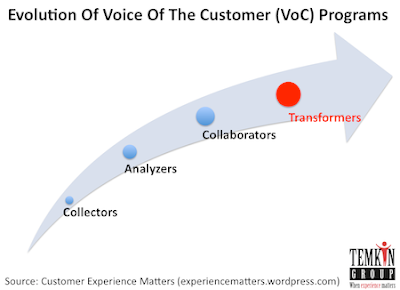
Bruce Temkin of the Temkin Group talks about Customer Experience maturity in a recent post in his blog Customer Experience Matters. http://experiencematters.wordpress.com/2010/05/19/how-voice-of-the-customer-programs-evolve/ He cites four stages of company evolution:
Can a company truly transform itself into a premier service organization, or must the company be "born" with that as its central mission?
It is easy to find examples of companies that make service excellence "the" key competitive dimension--think Zappos, Ritz, and JetBlue. But the question is whether these companies began ascendancy as premier organizations, or were transformed into premier organizations as a result of changes to a failed business strategy.
Bruce Temkin of the Temkin Group talks about Customer Experience maturity in a recent post in his blog Customer Experience Matters. http://experiencematters.wordpress.com/2010/05/19/how-voice-of-the-customer-programs-evolve/ He cites four stages of company evolution:
- Collectors--company focuses on getting the right data.
- Analyzers--company focuses on uncovering insights from the data.
- Collaborators--data insights are used to help departments understand issues, help continuous improvement efforts.
- Transformers--data insights are linked into most departments operations and strategy.
Bruce estimates that 40% of companies trying to create a premier customer experience are in the Collector stage, 40% are in the Analyzer stage, 18% are Collaborating, and only 2% are actually Transforming.
What does this say? It says that although many companies are indicating they want to invest in delivering premier customer service, few are getting any benefit from their efforts. Only 20% are getting the customer's voice into their decision making, and only 1 in 50 companies are actually making the customer central to their operations and strategy.
Since there are companies that are truly Customer-centric in their approach, this begs the question: did these companies follow the steps that Temkin outlines, or did they grow up already transformed. Can companies evolve?
My View:
Ouch! This data further confirms my belief that senior management in many companies are saying the words (80% of companies say they want to compete based on superior customer experiences) but are not doing what is necessary to get there. This strategic positioning runs the risk of being a "thing"--something all companies have to say because it is fashionable to do so--rather than a substantive business initiative.
Many companies that are the benchmarks for premier service have benefitted in terms of marketshare from that positioning, and have grown profitably as a result. Without knowing the companies Temkin has listed in the 2%, my bet is that many of them have grown up as "transformers."
Does this mean that if your company is in the middle of the service experience pack today that it cannot differentiate itself in the future? Not at all. But the executive "rubber meets the road" work begins when the company has gathered data and gained insight. The executive needs to make critical organizational changes that features that data, improves customer experience based on that data, and makes business priorities using the voice of the customer. In short, the executive needs to believe in the strategy and the data, and drive the company.
Without that, the company will never evolve and reach tranformative stages. Most will not. Enlightened and focused companies can.
Sunday, March 28, 2010
Companies That Service Their Customers Well Are Happy Companies...Like Zappos
Success Magazine has named Zappos CEO its 2009 Achiever of the Year, using the subtitle: Zappos CEO Tony Hsieh elevated customer experience to a new level

While this online shoe and accessory retailer has grown extraordinarily over the past five years and recently sold to Amazon, it is Hsieh's comments about delivering customer service that I find refreshing.
"The thing we realized this year that sort of ties everything together is that customer service is about making customers happy, and the culture is about making employees happy. So, really, we're about trying to deliver happiness, whether it's to customers or employees, and we apply that same philosophy to vendors as well."
It is refreshing to hear things like "create fun and a little weirdness" or "deliver wow through customer service." These are a part of Zappos's Core Values. Love that.
At one of my companies, we instituted "Wow Wednesday" when we celebrated the week's service victories...handing out magnets to be displayed on metal shelves like arrowheads on college football helmets--gold if a client recongized you, silver if a colleague recognized you. Every month, the division got together to count magnets and celebrate.
My View
When companies strive to compete by delivering superior service, they must transform their entire organization to embrace it.
You can't just perform customer service, you must be a customer service company.
It is very difficult for executives to accomplish, particularly in larger companies where each division may find itself in different competitive arenas. But it is clear that in order to be the best, the entire company's focus--from management to phone reps, from the technology department to the finance staff--has to be about delivering service.
Critical as well is having the inspirational leader like Hsieh leading the charge. This cannot be a mid-level initiative.
Can Zappos continue to prosper as a premier customer experience provider within a much larger Amazon? Time will tell, but the foundation is there.

While this online shoe and accessory retailer has grown extraordinarily over the past five years and recently sold to Amazon, it is Hsieh's comments about delivering customer service that I find refreshing.
"The thing we realized this year that sort of ties everything together is that customer service is about making customers happy, and the culture is about making employees happy. So, really, we're about trying to deliver happiness, whether it's to customers or employees, and we apply that same philosophy to vendors as well."
It is refreshing to hear things like "create fun and a little weirdness" or "deliver wow through customer service." These are a part of Zappos's Core Values. Love that.
At one of my companies, we instituted "Wow Wednesday" when we celebrated the week's service victories...handing out magnets to be displayed on metal shelves like arrowheads on college football helmets--gold if a client recongized you, silver if a colleague recognized you. Every month, the division got together to count magnets and celebrate.
My View
When companies strive to compete by delivering superior service, they must transform their entire organization to embrace it.
You can't just perform customer service, you must be a customer service company.
It is very difficult for executives to accomplish, particularly in larger companies where each division may find itself in different competitive arenas. But it is clear that in order to be the best, the entire company's focus--from management to phone reps, from the technology department to the finance staff--has to be about delivering service.
Critical as well is having the inspirational leader like Hsieh leading the charge. This cannot be a mid-level initiative.
Can Zappos continue to prosper as a premier customer experience provider within a much larger Amazon? Time will tell, but the foundation is there.
Friday, May 15, 2009
Companies Must Organize Differently to Deliver "Perfect Improvement"
When a typical company decides to undertake a "quality improvement" program, it creates "quality improvement teams" with members from different functional areas. The team members belong to the QITs in addition to their real job...which hasn't changed. Program progress, if any, is made outside of the true business. Often, these programs collapse of their own weight since people's "real" jobs will take priority.
In the "Perfect Service" approach, "Perfect Improvement" is imbedded into everyone's jobs. One of the taglines my team has used is: Perfect Service--The Way We Do Business.
So what is the best way to organize? I believe a three-way attack of satsifaction data is the best method.
--First, the Client Service team is responsible for improving that client's satisfaction. Each time their client's data arrives, the team must look at the results for satisfaction levels. When levels are less than stellar, the team is responsible for "fixing the situation," ie, assuring the issue is investigated, analyzed, and resolved for that client. Even if the problem is wider than just that client, the client team is responsible for insulating their client from future impact, until the overall "problem is solved."
--Second, the Operations Team responsible for each transaction that is measured is responsible for improving the satisfaction with their respective services. Whenever a client survey arrives for their service transaction, the Operations Team needs to understand the details of the result, and combine it with the results of other clients. The Operations Team is then responsible for "solving the problem." By reviewing their transactions across clients, this team is able to prioritize improvement efforts based on impact to overall client satisfaction.
--Third, Key Satisfaction Teams are organized to review and improve satisfaction scores of specific Key Success Factors (KSFs). Similar to the Operations Team, these teams are responsible for reviewing data across clients and transactions for their specific KSF. This team is then able to prioritize improvement efforts based on impact to overall client satisfaction.
This three-way or "cubed" review and analysis of data allows management to invest in those areas that will have the largest return on investment (in terms of satisfaction). Meanwhile, while business management is investing here, Client Service leadership is making sure the client is made happy right away.
Both Client Service teams and Operations teams are attacking the deficient results as part of their job, and evaluated based on their ability to move the satisfaction needle.
In the "Perfect Service" approach, "Perfect Improvement" is imbedded into everyone's jobs. One of the taglines my team has used is: Perfect Service--The Way We Do Business.
So what is the best way to organize? I believe a three-way attack of satsifaction data is the best method.
--First, the Client Service team is responsible for improving that client's satisfaction. Each time their client's data arrives, the team must look at the results for satisfaction levels. When levels are less than stellar, the team is responsible for "fixing the situation," ie, assuring the issue is investigated, analyzed, and resolved for that client. Even if the problem is wider than just that client, the client team is responsible for insulating their client from future impact, until the overall "problem is solved."
--Second, the Operations Team responsible for each transaction that is measured is responsible for improving the satisfaction with their respective services. Whenever a client survey arrives for their service transaction, the Operations Team needs to understand the details of the result, and combine it with the results of other clients. The Operations Team is then responsible for "solving the problem." By reviewing their transactions across clients, this team is able to prioritize improvement efforts based on impact to overall client satisfaction.
--Third, Key Satisfaction Teams are organized to review and improve satisfaction scores of specific Key Success Factors (KSFs). Similar to the Operations Team, these teams are responsible for reviewing data across clients and transactions for their specific KSF. This team is then able to prioritize improvement efforts based on impact to overall client satisfaction.
This three-way or "cubed" review and analysis of data allows management to invest in those areas that will have the largest return on investment (in terms of satisfaction). Meanwhile, while business management is investing here, Client Service leadership is making sure the client is made happy right away.
Both Client Service teams and Operations teams are attacking the deficient results as part of their job, and evaluated based on their ability to move the satisfaction needle.
Wednesday, April 29, 2009
Commit To Delivering "Perfect Service"
This blog is targeted to management within Service Delivery companies who truly want to be able to say "Our company delivers the best service in the industry!" and then deliver on that promise. Sadly, I have found that most companies will say the words--even put it is some sort of company values or vision statement--but then never commit to deliver. It is not enough to say it; a company must be it.
"Perfect Service" is an approach to managing a Service Delivery company that transforms the focus of the company to totally satisfying the customer. And when a company begins that journey, magical things begin to happen:
--Customers begin to openly communicate with you;
--Satisfaction ratings begin to soar;
--Sales presentations begin to focus on tangible evidence of satisfaction;
--Conversations are less about cost and fees;
--Employee evaluations become simpler;
--And incredibly, costs to operate go down!
Over time, "Perfect Service" will retain and attract more customers--at lower overall cost and at premium fees.
The next few posts will walk you through the elements of "Perfect Service."
"Perfect Service" is an approach to managing a Service Delivery company that transforms the focus of the company to totally satisfying the customer. And when a company begins that journey, magical things begin to happen:
--Customers begin to openly communicate with you;
--Satisfaction ratings begin to soar;
--Sales presentations begin to focus on tangible evidence of satisfaction;
--Conversations are less about cost and fees;
--Employee evaluations become simpler;
--And incredibly, costs to operate go down!
Over time, "Perfect Service" will retain and attract more customers--at lower overall cost and at premium fees.
The next few posts will walk you through the elements of "Perfect Service."
Subscribe to:
Posts (Atom)